

LSEG Labs recently published an interesting survey on the growing importance of data analytics, ML and AI among finance firms globally. Firms are increasingly recognising the benefits of technology, and partnering with modern tech providers is key to realising those benefits. But challenges still exist for firms looking to deploy ML at scale. Below, we’ll look at some of those challenges, along with some tools and best practices that can help capital markets firms adopt and benefit from AI and ML strategies.
At a high level, the challenges faced in capital markets when performing AI are similar to other industries. The first set of challenges comes from the data itself. Many firms face the limitations of on-premise and legacy applications that don’t work well either with each other or with newer cloud-based tools. Hence data science is often not limited by the velocity or volume of data, but by the huge variety of different data sources and formats. Complicating the picture further, as the figure below illustrates, firms need to increasingly integrate unstructured data into some sort of coherent framework. In order for any institution to get the most out of their data analytics platform, data from multiple systems must first be consolidated into a central database. This is where a dedicated data analytics partner can help with design and deployment.

Other challenges can also include institutional inertia, regulatory restrictions and skills limitations within an enterprise’s IT teams. An even bigger challenge is that effective AI and ML depend upon a robust and flexible data analytics platform. Without a strong core data infrastructure, it’s hard to perform data science in production. As noted in the Harvard Business Review “If your company isn’t good at analytics, it’s not ready for AI.” So an integral first step is to develop and deploy a strong platform that can do this securely and provide strong data governance, security rules, and regulatory compliance within IT.
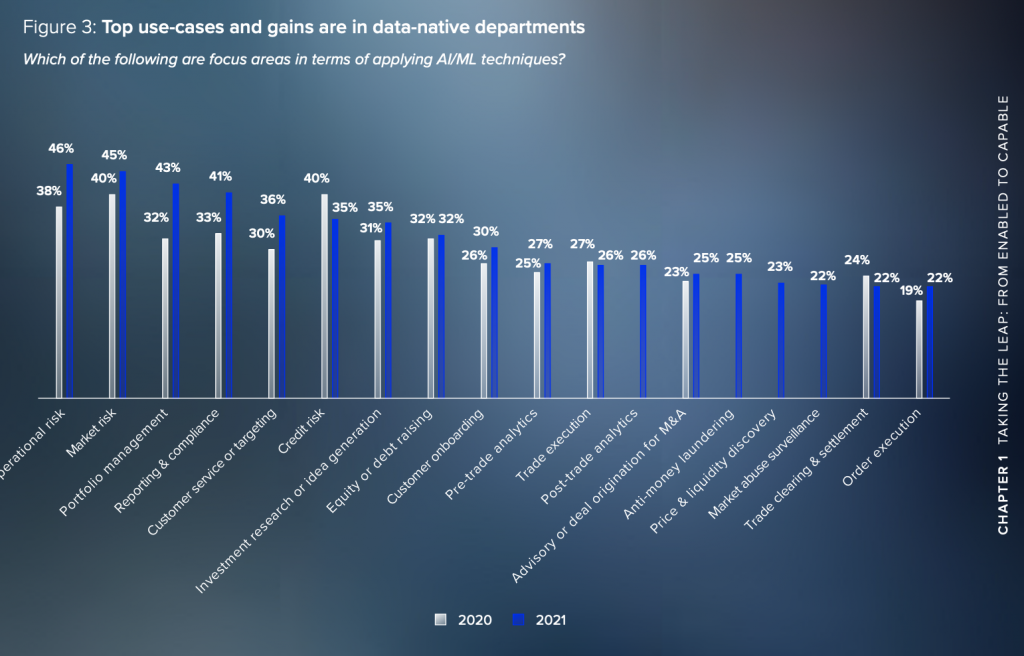
It is also important to identify where to focus your efforts. Below are a number of common use cases for AI that have arisen in the capital markets sector. The chart illustrates that most survey respondents see most of the top 2020 use cases assuming even greater importance in 2021. In addition, post-trade analytics, one of our key focus areas, was identified for the first time in the survey as a key use-case.
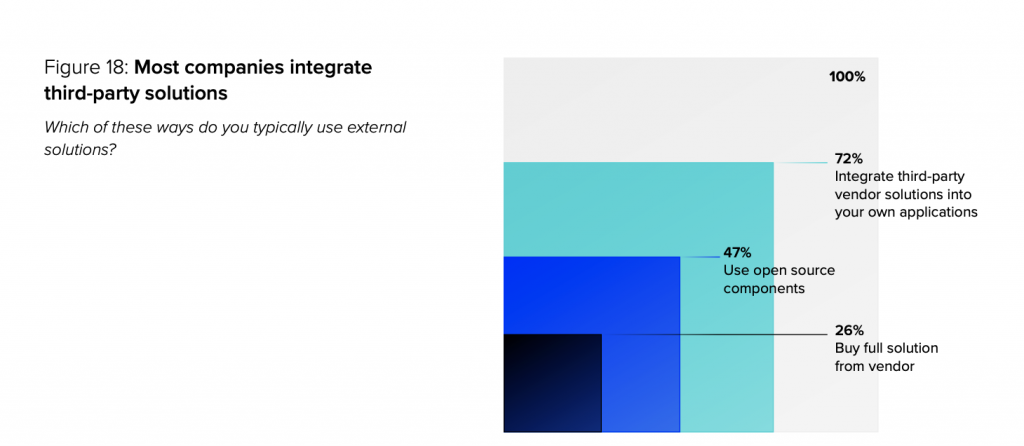
The global growth in AI/ML adoption also presents financial services companies with a multitude of choices around whether to build capabilities in-house or rely on external applications and vendors. This year, only 37% of companies reported building the majority of their capabilities in-house. However, buying full solutions from a vendor was still a minority choice. This year, the survey found that most companies prefer to integrate third-party solutions into their internal applications, and nearly half choose to use open source components.

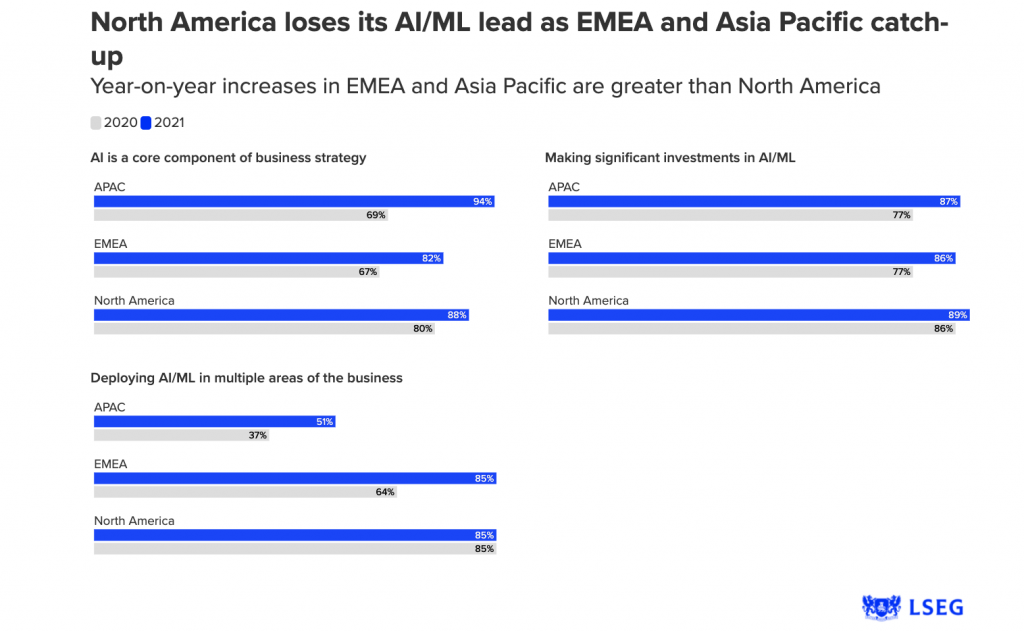
A final interesting takeaway was that companies in both Asia Pacific and EMEA perceive AI/ML as a core component to business strategy far more than was the case last year. In EMEA, 82% of respondents believe this to be the case, up from 67% last year. In Asia Pacific, 94% say AI/ML is core to the business strategy, up from 69% last year.
With global spending on AI forecast to double over the period 2020-24, growing from $50bn in 2020 to more than $110bn in 2024 (IDC, 2020), it’s clear that the COVID-19 crisis has accelerated and intensified the digitalisation trend that was already observed prior to the pandemic, including around the use of AI/ML. Growing AI/ML adoption in finance, enabled by the abundance of available data and by increased, and more affordable, computing capacity will increasingly drive competitive advantages for the financial firms that adopt these new technologies and further disadvantage those that don’t.