

AI is a technology that is disrupting many industries at present. It has impacted industries as diverse as software, finance, agriculture, music, shopping and the list continues to grow. The application of AI may differ according to the industry but the challenge of getting the right quantity and quality of data to feed to the models is often a universal limiting factor.
AI is being increasingly used across finance and banking. Many startup fintech companies are using AI to disrupt incumbents with new services and existing players are using ML and AI to assist in credit card fraud detection, credit scoring and enhanced customer service through the use of chatbots.
Within capital markets, many segments, particularly equities and foreign exchange, have large amounts of high quality datasets for AI models to learn from and make accurate predictions.
Bond markets have many interesting AI applications too. Although more challenging to analyse due to less liquidity, a multiplicity of bond issues versus stock issues, a larger degree of OTC versus electronic trading and lack of price transparency, AI can still help make sense out of the large volumes of data around bond trading.
Bond Price Prediction
Bond prices over the time are a reflection of extremely complex market interactions and policies, making prediction of future prices difficult. This task becomes even more challenging due to the dearth of relevant information and accuracy is not the only consideration. In trading situations,
time is of the essence. Thus, machine learning in the context of bond price predictions should be both fast and accurate.
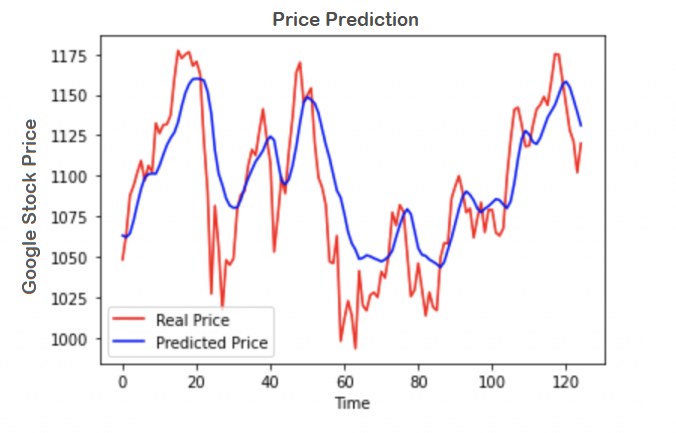
Bond or Stock Price Prediction is a time series forecasting problem which unlike regression predictive modelling, also adds the complexity of a sequence dependence among the input variables. Thus making it a much more complex problem to solve. A powerful type of neural network designed to handle sequence dependence is called RNN (Recurrent Neural Network). The Long Short-Term Memory network or LSTM network is a type of recurrent neural network used in deep learning because very large architectures can be successfully trained using it. Though resource intensive, this type of modelling adds efficiency and accuracy as can be seen in the stock price prediction illustration below .
Client Preference Analysis
Asset managers generally have asset preferences predicated on a variety of criteria today and over time . These preferences could include individual security, industry group, duration or country preference among other. Preference determination could be of particular interest to traders as not only can inventories be managed more efficiently in aggregate, it also becomes easier to make specific and targeted recommendations once client preferences are better understood.
We can develop a lot of hidden state models to help tease out preferences. These models can be very useful in giving real time insights to traders.
Anomaly Detection
Anomaly models can be used to help detect any unusual behaviour on behalf of a client. Incoming enquiries can be assessed according to a variety of parameters against historical trading patterns. Any deviations from “normal” behaviour can be highlighted in real time.
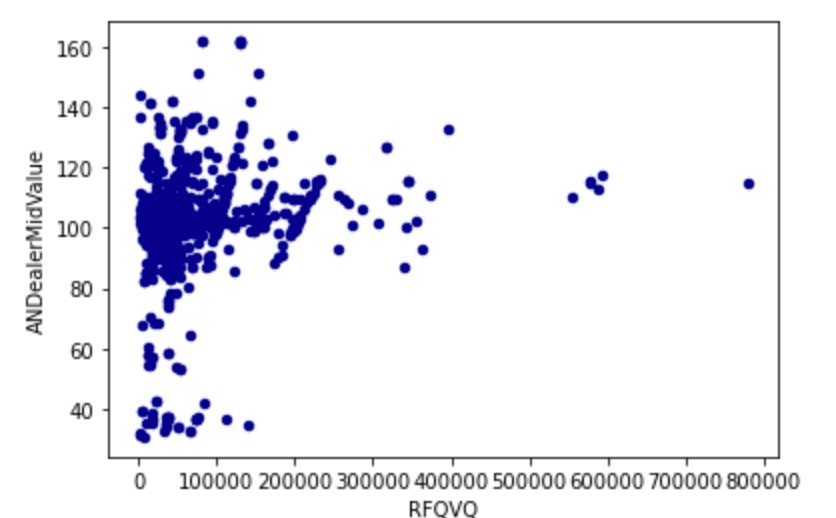
Here in the above image you can clearly see the pattern of a particular client in terms of all their inquiries sent to the bank. The cluster suggests the range around mid prices at which the client sends inquiries. Hence receiving inquiries outside the cluster can be considered an anomaly.
Client Clustering
The client themselves can be clustered on various parameters giving the traders an insight to rank them.
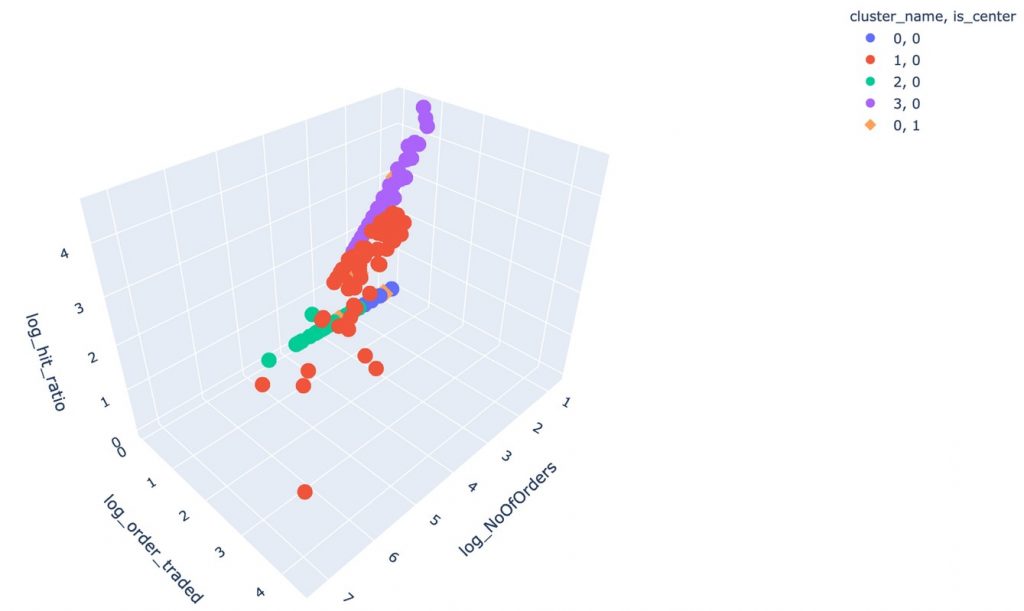
The above example clusters clients based on hit-ratio, order traded and total number of orders. Using such an approach can help traders understand the quantity and quality of business with an account in real time.
Natural Language Processing
Natural language processing also has a wide usages in bond trading. The ability to quickly categorise news on the basis of enitity and even associate relevant news with open positions and incoming enquires is an obvious use case. Additionally, sentiment indicators across securities and sectors are also likely to be of great interest to traders. Another interesting application is the merging of different sources including news feeds, emails, research reports into a consolidated stream of information ensuring that nothing of importance is missed and that the institution is fully utilising all of the relevant data at its disposal.
Conclusion
Advances in AI and ML technology have unlocked a lot of potential in efficiently handling the bond pricing challenge, picking up anomalous behaviour by a client, noticing market sentiments in real time and the list goes on. The growing impact of this technology will eventually lead to faster trading, more velocity and opportunities to use advanced analytics to make smarter decisions.